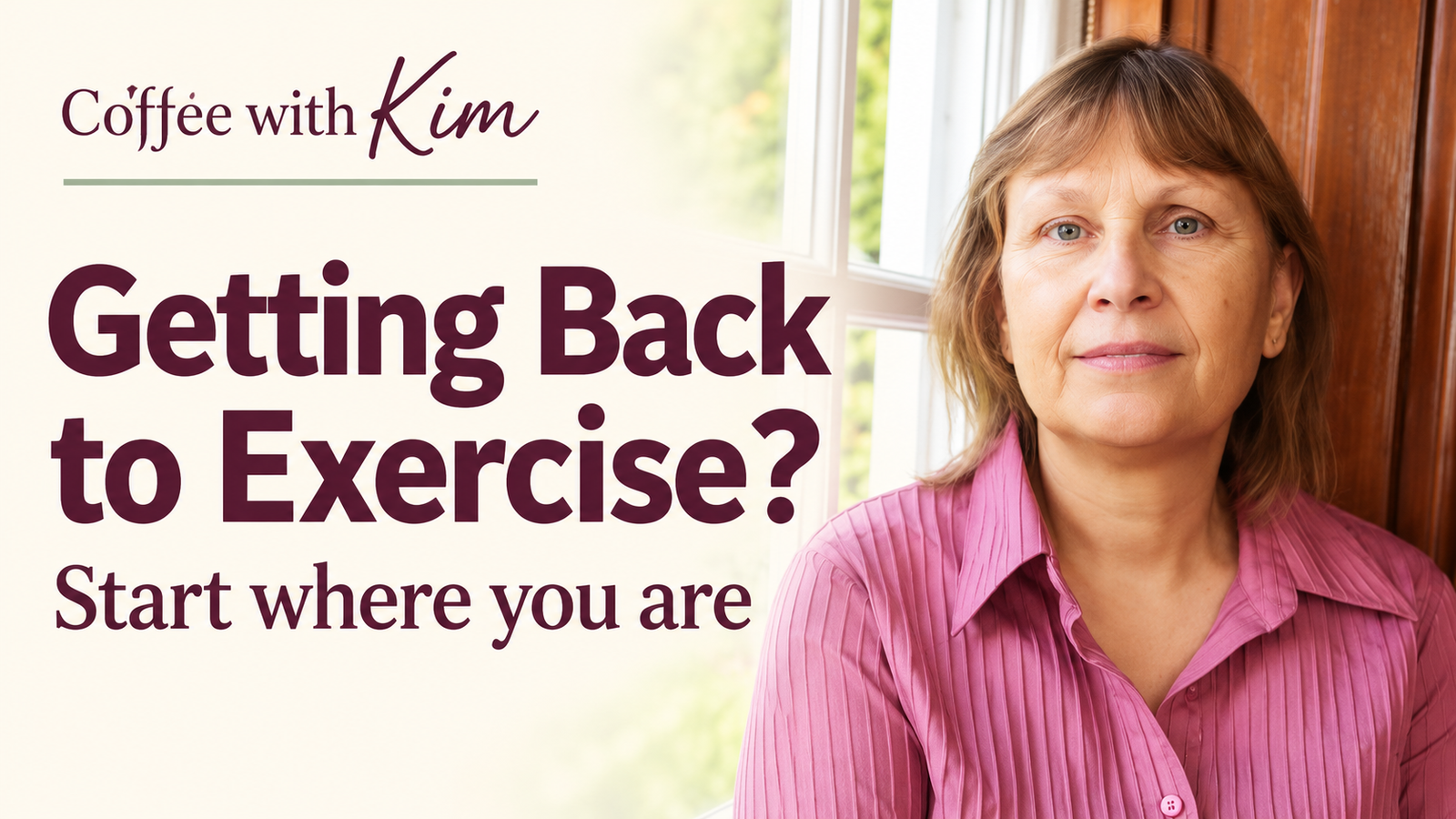
Getting Back to Exercise: Where Do You Start?
Have you ever thought, “I really need to get back to exercise,” and then immediately wondered where on earth to begin?
Perhaps you’ve been unwell, an injury has changed what you can manage, or life has simply pushed your usual routine aside. You might miss your favourite class or remember when a walk felt easier. And the longer the break lasts, the more daunting that first step can become.
You don’t have to make up for all the exercise you’ve missed. A useful place to begin is with one question:
What feels manageable for me today?
I’m finding my own way back too
With over 35 years of teaching exercise, you might imagine that keeping active is always straightforward for me. But knowing about exercise and navigating your own return to it are two different things.
Just over two years ago, I sustained an injury that continues to affect what I can comfortably do. It has changed my own exercise and made filming some of my WalkFit videos more difficult.
I’m keeping the details private, but I want to acknowledge this because I’m working through some of the same frustrations that you may recognise.
About a year after my injury, I decided to walk down to the local canal. It was a route I knew well from leading regular walks with an older group — something I had previously considered gentle.
That day, I turned back earlier than planned and struggled with the hill on the way home. Finding a familiar walk so difficult was upsetting.
Experiences like that can knock your confidence. They can also make it tempting to measure every attempt against what you used to do.
I have to remind myself to offer myself the same patience I would offer someone coming to one of my classes.
If a friend were struggling after a difficult year, I wouldn’t expect her to pick up exactly where she left off. I’d encourage her to find a suitable starting point.
We deserve that same understanding ourselves.
Your old routine isn’t a test you have to pass
The phrase “getting back to exercise” often brings an earlier version of ourselves to mind.
The person who attended a class every week. The person who walked further. The person who could finish a workout without thinking much about it.
But your circumstances may have changed. Your health, responsibilities, energy and available time might all be different now.
Your previous routine can give you ideas, but it doesn’t have to set the standard for today.
Try replacing:
“Why can’t I do what I used to do?”
With:
“What would be a useful starting point for me now?”
You’re allowed to feel disappointed about changes while still finding a way forward.
Make the first decision smaller
It’s easy to turn restarting into a complete life overhaul.
From Monday, you’ll exercise every morning, walk every afternoon, eat differently and get to bed earlier. Then something interrupts the plan, and by Thursday it feels as though you’ve failed.
Sometimes the plan simply asks for too much change at once.
Instead, begin with three decisions:
- Choose one activity that suits your current needs.
- Choose one realistic opportunity to do it.
- Choose an amount that feels manageable within any guidance you’ve been given.
That might mean a short section of a suitable workout, a brief walk or exercises recommended by your physiotherapist.
There is no universal starting amount. Five minutes might feel easy for one person and be too much for another.
And pressing play on a fifteen-minute workout doesn’t commit you to finishing it. You can pause, stop or leave out a movement that isn’t appropriate for you.
Your body, your workout applies when you do less, too.
Think about what you want exercise to help you do
“Get fitter” can feel rather vague.
Your reason might be that you want to feel more confident going out, take part in family activities or have something in the week that belongs to you.
Perhaps you simply miss enjoying movement.
Try completing this sentence:
“I’d like to get back to exercise because…”
You don’t need an impressive answer. An honest, personal reason can help you choose an activity that matters to you.
For me, enjoying my own movement and creating workouts to share with you are important. I still need to approach both in a way that respects what I can manage.
Choose something that suits your life now
You don’t have to begin with the activity you think you “ought” to do.
Consider these questions:
- Does this suit my current needs?
- Can it fit into my actual week?
- Is it something I would feel comfortable doing again?
You might prefer a seated option, standing with support, a slower pace or a familiar routine.
A seated workout still needs to be appropriate for you — sitting down doesn’t automatically make every movement suitable for every injury.
If getting down to the floor is difficult, you don’t have to start on the floor. If fast choreography leaves you flustered, choose something simpler.
You’re choosing a starting point, not committing to one type of exercise forever.
Make starting easier
“I’ll exercise when I have time” can leave your plans at the bottom of a very long list.
It may help to connect your activity with something that already happens: after breakfast, after work or at a quieter point in your week.
Choose a time that genuinely works for you. There is no prize for planning morning exercise if your mornings are already chaotic.
A little preparation can help, too. Choose your video beforehand, clear a suitable space and have any equipment ready.
It’s also useful to have an alternative. If the day changes, could you choose a shorter suitable activity? Would another option fit better? Or does today call for rest and another look at the plan later?
Flexibility gives a routine room to survive real life.
Consider the whole day
When you’re deciding what is manageable, remember that exercise is only one part of your day.
Shopping, cleaning, gardening, caring responsibilities and time on your feet all make demands on you.
A day when you feel better can be particularly tempting: you want to exercise and catch up on everything else. It helps to consider the total rather than the workout alone.
Notice how you feel during activity and afterwards. If you’re managing an injury or health condition, ask your healthcare professional what responses are acceptable for you and what should prompt an adjustment.
“Listen to your body” can be difficult to interpret. You’re allowed to ask more specific questions.
Notice progress beyond minutes and steps
Progress might mean walking further or doing more repetitions. But when you’re restarting, other changes deserve recognition.
Perhaps you found a routine that fits your day. Perhaps beginning feels less daunting. Perhaps you adapted a session sensibly or found a class you’d like to attend again.
You don’t have to increase something every week. Repeating an amount that suits you can give you time to become comfortable with it.
Where increasing activity is appropriate, make a small change and notice your response rather than changing everything at once.
Remember the people, too
When exercise disappears from your week, you may miss more than movement.
You might miss familiar faces, conversations before class or having somewhere to go where people notice you.
If you’re considering returning to a group, speak to the instructor. Explain what has changed and any guidance you’ve received, then discuss whether the class and possible adaptations are suitable.
If taking part isn’t appropriate yet, keeping in touch with the people you miss may still be possible.
That connection matters.
A missed day doesn’t undo your efforts
Appointments overrun, sleep is disrupted and other people need us. Sometimes we simply forget.
One missed session doesn’t mean you can’t build a routine. You don’t need to compensate with twice as much next time or wait until Monday to begin again.
Ask whether the plan needs adjusting, then choose your next manageable opportunity.
What is your first step?
Your next step might be choosing a suitable video, contacting a class instructor, asking for individual advice or making a little space in your week.
I’m asking myself the same questions. My injury and family responsibilities have changed parts of my routine, and I’m still finding my way.
You don’t have to have everything worked out before making one useful decision.
What feels manageable for you now?
I’d love to hear your first step in the comments. Share only what you feel comfortable sharing — there’s no need to include private medical details.
You can find Coffee with Kim conversations and workouts on my Keep Fit with Kim YouTube channel.
Your body, your workout.
Kim is a Chartered Activity & Health Practitioner, personal trainer and Pilates instructor with over 35 years of teaching experience.
This article provides general information, not an individual rehabilitation plan. When returning after illness, injury or surgery, follow advice appropriate to your circumstances. If activity causes new or worsening symptoms, or leaves you significantly more unwell afterwards, seek individual advice rather than pushing through.